Choose the Right Printer Investment
Replacing or expanding a printer fleet requires more than comparing a purchase price with a monthly payment. Leaders must also consider toner, maintenance, downtime, energy use, IT support, security updates, and replacement costs across global organizations.
The best printer lease vs buy decision depends on cash flow, print volume, growth, technology requirements, and total cost of ownership. Leasing often supports predictable spending and easier upgrades. Buying can provide better long-term value when usage is stable and the organization can manage service responsibly.
Printer Lease vs Buy: The Quick Answer
Leasing may suit businesses that want lower upfront spending, regular payments, service coverage, and easier technology refreshes. Buying may suit organizations with available capital, predictable requirements, and plans to keep equipment for several years. A printer leasing vs buying comparison should assess the entire print environment, not only the acquisition price.
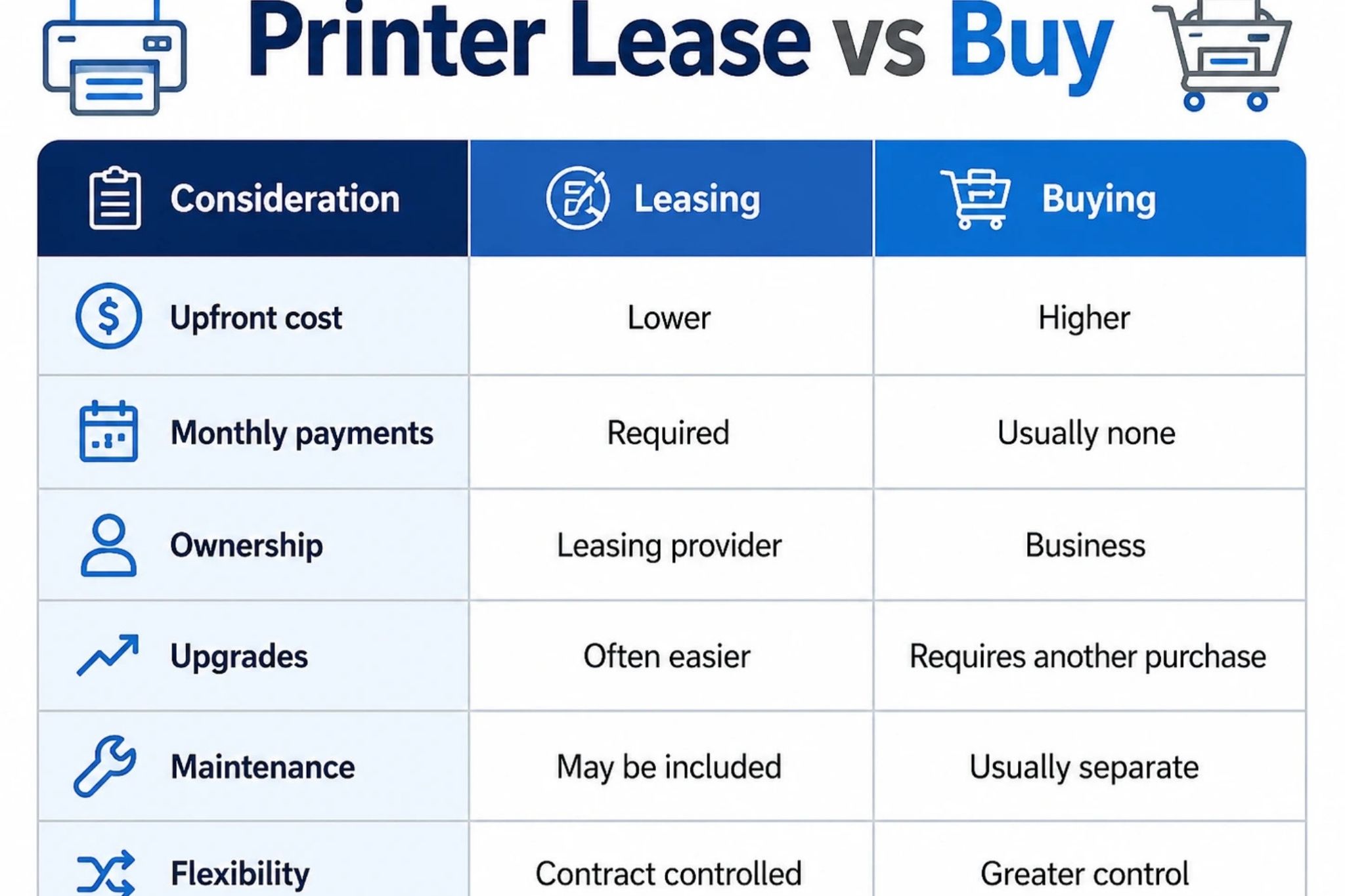
The U.S. Small Business Administration recommends reviewing business needs and financial implications when deciding whether to buy or lease business equipment.
What Does Leasing an Office Printer Mean?
With office printer leasing, a business makes scheduled payments for a defined term. The agreement may include the device, repairs, monitoring, maintenance, and toner, but leaders should verify every inclusion.
Benefits can include lower initial spending, predictable expenses, current technology, and easier fleet expansion. A business printer lease may also reduce pressure on internal IT when support is included.
Risks include early termination fees, automatic renewals, annual increases, page minimums, overage charges, and end-of-term return requirements. When reviewing copier lease vs buy proposals, compare the complete contract rather than the advertised monthly payment.
What Does Buying an Office Printer Mean?
Buying provides ownership and control. The business can relocate, sell, or replace the device without lease restrictions, and reliable equipment may cost less over time.
However, the owner remains responsible for toner, preventive maintenance, repairs, monitoring, and replacement planning unless a separate service agreement is added. Purchased equipment may qualify for depreciation or other tax treatment under business equipment depreciation rules. Consult a qualified tax professional before using tax assumptions in a copier lease vs buy decision.
Seven Factors to Compare Before Leasing or Buying
1. Upfront Cost and Cash Flow
Office printer leasing preserves working capital and spreads costs across the agreement. Buying requires more cash initially but eliminates the continuing lease obligation.
2. Monthly Print Volume
Measure pages by device, department, and site. An undersized printer may fail more often, while oversized equipment wastes capital. A business printer lease may also include minimum volumes or overage charges.
3. Maintenance and Repairs
Confirm whether labor, parts, preventive service, and replacement devices are covered. Ownership can appear cheaper until repair costs and employee downtime are included.
4. Contract Terms
Review the term, automatic renewal, cancellation fees, annual increases, page allowances, supply exclusions, and end-of-lease conditions. A managed print services contract should separate hardware, service, supplies, and usage charges clearly.
5. Technology and Security
Consider secure print release, cloud workflows, scanning, firmware support, and vendor updates. In 2025, the National Vulnerability Database documented CVE-2025-34217, a print-management vulnerability involving a hardcoded SSH key that could permit root access. The vulnerability record shows why global organizations need security lifecycle planning.
6. Scalability
Leasing may simplify adding or refreshing equipment as offices grow. Purchasing can work when headcount and workflows are stable. Standardizing your printer fleet can also reduce supply complexity, support demands, and downtime.
7. Total Cost of Ownership
Include payments or purchase price, toner, repairs, maintenance, energy, IT labor, downtime, cost per page, and disposal. ENERGY STAR applies efficiency and power-management criteria to energy-efficient printers and multifunction devices, making energy use part of the long-term comparison.
Before signing a lease or approving a major purchase, request a printer fleet assessment. LAComputech can identify usage patterns, hidden costs, inefficient devices, and right-sizing opportunities.
How Managed Print Services Fit Both Options
A managed print services contract can support leased or purchased devices. For leased printers, it may combine hardware, monitoring, maintenance, supplies, support, and planned refresh cycles into predictable monthly expenses.
For purchased equipment, Managed Print Services can monitor usage, automate toner replenishment, maintain devices, identify underused equipment, and plan replacements.
LAComputech Managed Print Services begins with an assessment of devices, volume, workflows, cost per page, service history, security needs, and growth plans. LAComputech can then right-size the fleet, replace inefficient desktop printers with suitable multifunction devices, and help reduce business printing costs.
Printer Leasing vs Buying by Industry
Healthcare Providers
Healthcare facilities need reliable forms, labels, records, and patient communications. Leasing may support uptime and security updates, while ownership may fit stable departments.
Educational Institutions
K-12 schools and colleges face seasonal demand and fixed budgets. Centralized multifunction printers may replace costly desktop devices, but leaders should compare procurement rules and service coverage.
Government and Public Agencies
Public agencies may prefer ownership for longer lifecycles. Office printer leasing can improve budgeting and standardization when contracts are transparent.
Regulated and Growing Offices
A common real-world example is a growing medical group opening two clinics. It might lease standardized multifunction devices under one service plan while keeping productive purchased printers in stable departments. This hybrid approach limits unnecessary replacement and creates consistent support across multi-site or global operations.
Decision Checklist
Before making the printer lease vs buy decision, ask:
-
How many pages does each department print?
-
What is the current cost per page?
-
How much capital is available?
-
Are maintenance, parts, and toner included?
-
How quickly will the organization grow?
-
Will the equipment receive security updates?
-
What happens when the lease ends?
-
How much IT time supports printers?
-
Could fleet consolidation reduce waste?
-
Does the managed print services contract match actual usage?
Build a Predictable Print Strategy with LAComputech
The right printer lease vs buy choice should improve cost control, productivity, security, and scalability. LAComputech helps healthcare providers, educational institutions, regulated businesses, local governments, public agencies, and global organizations assess usage, right-size equipment, compare acquisition options, and manage maintenance and supplies.
Schedule a printer fleet assessment to create a predictable print strategy aligned with your budget, workflows, and long-term technology needs.
Frequently Asked Questions
Is It Cheaper to Lease or Buy a Business Printer?
Buying may cost less when a reliable device remains productive for years. Leasing may offer better cash-flow predictability and bundled support.
Can Managed Print Services Cover Printers We Own?
Yes. Purchased devices can often be monitored, maintained, supplied, and optimized without a hardware lease.
How Long Should a Business Keep an Office Printer?
Keep it while it remains secure, reliable, supported, cost-effective, and appropriate for the required volume.
Can a Business Combine Leased and Purchased Printers?
Yes. A mixed fleet can work when every device has a clear operational and financial role. Apply the same printer leasing vs buying analysis across departments.