When IT Problems Interrupt the Next Production Shift
A manufacturing facility may have employees ready to work, but a network failure can still delay inventory updates, shipping documents, or access to essential business applications. When these problems occur during an evening shift, employees may not know who is responsible for resolving them.
Managed IT solutions help manufacturers plan monitoring, maintenance, and support around the systems employees depend on throughout the workday. For Louisiana businesses operating multiple shifts, the goal is to establish clear responsibilities before technology problems interrupt operations.
LAComputech provides managed IT services, including server management, remote monitoring, and onsite and remote technical support. The appropriate arrangement depends on the facility's systems, support needs, and operational schedule.
Why Manufacturing Businesses Need Reliable IT Across Shifts
Manufacturing operations depend on more than production machinery.
Office computers, network connections, inventory applications, wireless scanners, and shipping workstations help employees coordinate work across departments.
When these systems become unavailable, employees may experience:
-
Delayed inventory transactions and shipping documentation
-
Difficulty accessing production schedules or business records
-
Interruptions in communication between departments
-
Additional manual work and support requests
These problems can affect multiple shifts, even when the underlying issue begins during normal business hours.
For manufacturers, reliable technology support requires understanding which systems are essential and when employees need them.
Managed IT services for manufacturers should therefore be evaluated against actual operating schedules, not just standard office requirements.
Identify Critical Networks, Servers, and Business Applications
Before selecting a support arrangement, manufacturers should identify which technology systems directly support daily business operations.
Networks and Wireless Connectivity
Warehouse employees may rely on wireless scanners and mobile workstations to access inventory applications.
Unreliable Wi-Fi, switching issues, or network congestion can interrupt these workflows.
A factory office network support plan should account for office connectivity, warehouse coverage, application access, and the network equipment connecting these environments.
Servers and Business Applications
Manufacturers may depend on servers or cloud applications for purchasing, inventory management, scheduling, accounting, and shipping.
Decision-makers should document which applications are critical, their dependencies, and what employees should do when access becomes unavailable.
Workstations and User Access
Shared workstations, employee accounts, and application permissions also require attention.
When shifts change, employees need reliable access to approved systems without unnecessary administrative privileges.
An IT assessment should establish which systems require monitoring, who maintains them, and what support procedures employees should follow.
Plan IT Monitoring and Support Around Production Schedules
A manufacturing business operating two or more shifts may need technical visibility beyond the hours its administrative office is open.
Monitoring can help identify selected server, workstation, network, or application problems, but an alert does not automatically mean someone has investigated or resolved the issue.
Effective support planning should define:
-
Which systems are monitored.
-
Which conditions generate alerts.
-
Who receives and investigates notifications.
-
When an issue requires escalation.
-
How employees report problems during each shift.
LAComputech's existing remote IT monitoring guide explains why monitoring, investigation, and remediation are separate responsibilities.
The NIST Cybersecurity Framework 2.0 similarly distinguishes detecting cybersecurity events from responding to and recovering from them.
For manufacturing network downtime prevention, the practical objective is earlier problem visibility, clear escalation, and coordinated response, not a guarantee that outages will never occur.
Manufacturers evaluating after-hours coverage should confirm exactly what their IT agreement includes. Continuous monitoring, helpdesk availability, response times, and onsite assistance are different service commitments.
If recurring network issues are disrupting inventory, shipping, or employee access across shifts, LAComputech can help evaluate your business IT environment and discuss a managed support arrangement based on your operating requirements.
Coordinate Preventative Maintenance and Technical Escalations
Routine updates should not create avoidable interruptions during active production periods.
A shift-based IT maintenance plan should establish appropriate maintenance windows for business servers, workstations, networking equipment, and applications.
Schedule Updates Around Business Operations
IT teams should coordinate planned work with operations managers and relevant application owners.
Before making changes, confirm which applications depend on the affected systems, whether testing is required, and what recovery steps are available if a change causes problems.
LAComputech's preventative IT maintenance guide discusses how scheduling, monitoring, and maintenance planning fit into broader technology management.
Document Technical Escalations
Employees need a consistent process for reporting urgent problems.
For each shift, define who reports the issue, who coordinates troubleshooting, which vendors may need to be contacted, and who approves changes that could affect operations.
Verify Backup and Recovery Responsibilities
Manufacturers should identify which business applications and data require backups, how frequently those backups are performed, and who is responsible for recovery testing.
The CIS Controls v8.1 Data Recovery guidance recommends documented recovery processes, protected backup data, and recovery testing.
These responsibilities should be clear before a critical application becomes unavailable.
Separate Business IT Support From Industrial Operational Technology
Manufacturing environments often contain two different technology categories.
Information technology (IT) typically includes business networks, office computers, user accounts, email, business applications, and related infrastructure.
Operational technology (OT) includes specialized systems that monitor or control physical industrial processes, such as industrial controllers and production machinery.
These environments may connect, but they have different safety, reliability, and maintenance requirements.
The NIST Guide to Operational Technology Security explains why industrial systems require controls appropriate to their operational and safety characteristics.
Manufacturers should clearly establish whether business IT providers, internal engineering teams, equipment manufacturers, or specialized OT vendors are responsible for each system.
LAComputech's published managed IT capabilities do not, by themselves, establish that industrial machinery or specialized production-control systems are included in its service scope.
A Louisiana Manufacturer Operating Two Shifts
Consider a hypothetical fabrication company in Louisiana with a daytime production shift and an evening shipping shift.
Employees use wireless inventory scanners and shared workstations to update stock records and prepare shipping documents.
During the evening shift, scanners repeatedly lose connectivity. Employees temporarily switch to manual records, and the next shift must reconcile outstanding transactions.
A better support approach would investigate the wireless coverage, network connections, application dependencies, and timing of recurring failures.
Management could then establish monitoring requirements, an escalation contact for evening employees, and maintenance windows that avoid interfering with critical workflows.
The appropriate solution might involve configuration changes, equipment maintenance, network improvements, or adjustments to support procedures.
The goal is to address the underlying problem rather than repeatedly treating each interruption as an isolated incident.
Manufacturing Managed IT Solutions Assessment Checklist
Before requesting manufacturing IT support in Louisiana, review the following questions with plant management, operations leaders, and IT personnel.
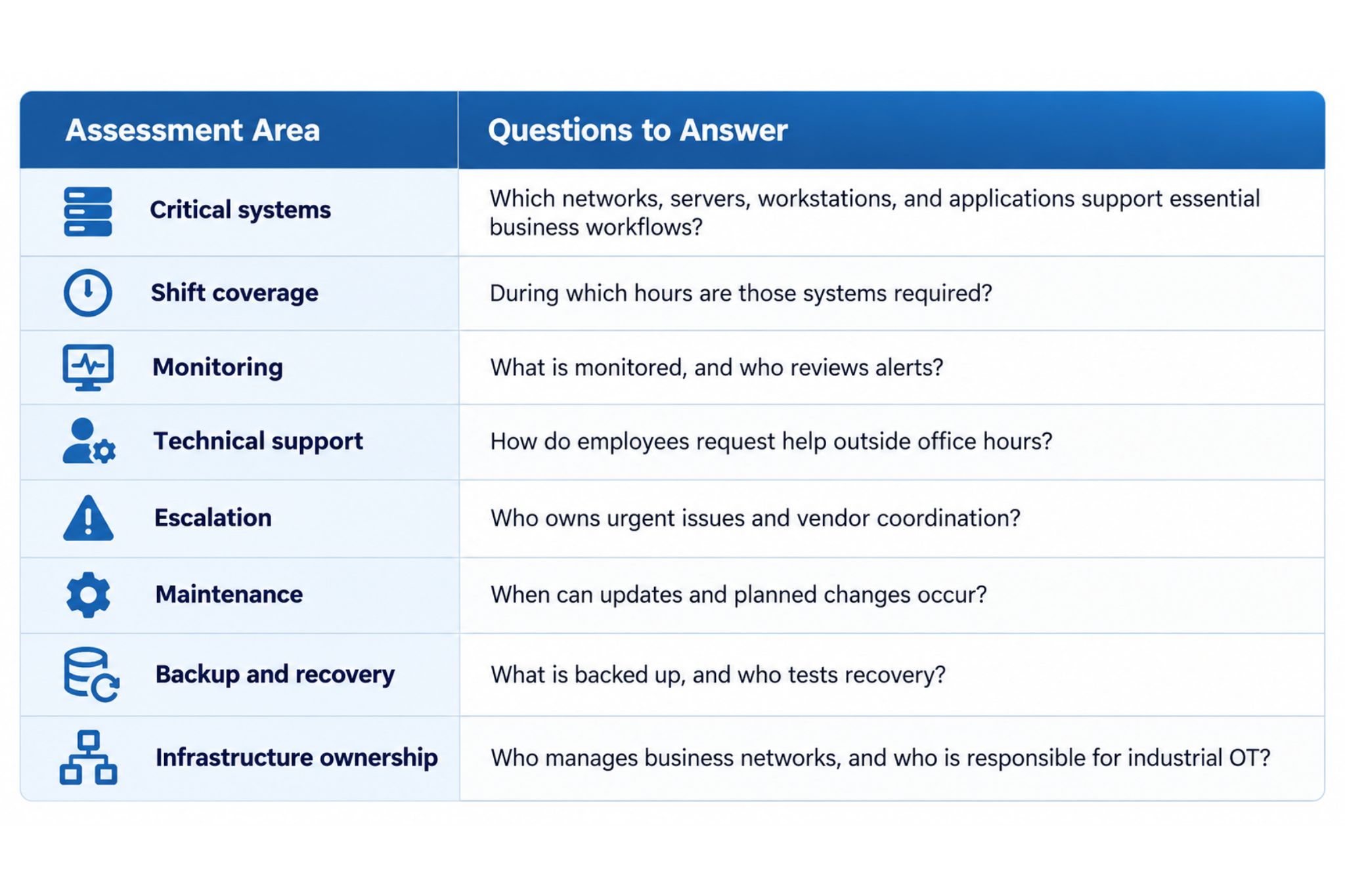
This checklist helps decision-makers identify gaps before comparing support providers or service agreements.
Build an IT Support Plan That Fits Your Manufacturing Schedule
Manufacturers need technology support that reflects how their employees actually work.
LAComputech offers managed IT solutions for Louisiana businesses, including remote monitoring, server management, and technical support.
If your manufacturing business experiences recurring network failures, application interruptions, or unclear IT responsibilities across shifts, discuss your environment with LAComputech.
Call (855) 252-8324 or request an IT consultation to review your critical business systems, shift schedules, existing support arrangements, and potential managed IT requirements.
FAQs
What are managed IT solutions for manufacturers?
Managed IT solutions provide ongoing management and support for selected business technology systems, including networks, servers, workstations, monitoring, and technical assistance. The exact services depend on the agreed scope.
Do manufacturers need IT support outside regular business hours?
Manufacturers operating evening, overnight, or weekend shifts may need support arrangements that reflect those schedules. Monitoring hours, escalation responsibilities, and response commitments should be confirmed before selecting a provider.
What is shift-based IT maintenance?
Shift-based IT maintenance involves scheduling updates, diagnostics, and other planned work around a company's operating schedule to limit unnecessary business disruption.
Can managed IT services prevent manufacturing downtime?
Managed IT services can support earlier problem detection, maintenance planning, troubleshooting, and recovery readiness. However, no IT provider can guarantee the prevention of every outage, and specialized industrial equipment may require separate support.