When Business Software Fails, and Vendors Disagree
Your accounting application stops working. The software vendor says the network is responsible, while the internet provider reports no connection problems. Employees remain unable to finish their work, and nobody knows who should take the next step.
Outsourced IT support can help businesses investigate these problems, document findings, and coordinate technical escalation when vendor communication is included in the service agreement.
For Louisiana businesses managing multiple providers, LAComputech's outsourced IT support and helpdesk services offer an option for establishing a more structured support process.
Why Business IT Problems Get Passed Between Vendors
Business applications often depend on several separate technology systems.
An employee may access a third-party application through an office network using an account managed by the business. The application itself may depend on cloud infrastructure operated by the software provider.
When something fails, each provider may investigate only the systems it manages.
For example:
-
The software company checks whether its application is operating.
-
The internet provider investigates connectivity.
-
Internal IT checks employee workstations and network access.
-
The account administrator reviews authentication or permissions.
The difficulty arises when nobody coordinates those findings.
Without clear ownership, employees may repeat the same explanation to several support teams, while the underlying issue remains unresolved.
A documented IT vendor escalation process helps establish who investigates first, when another provider becomes involved, and who follows up until the incident reaches a resolution.
Identify Who Owns Software, Network, and Access Issues
Effective business application troubleshooting begins by separating the problem from assumptions about its cause.
A software error does not automatically indicate a software defect. Likewise, a failed connection does not always mean the internet service is down.
The following responsibility matrix provides a starting point.
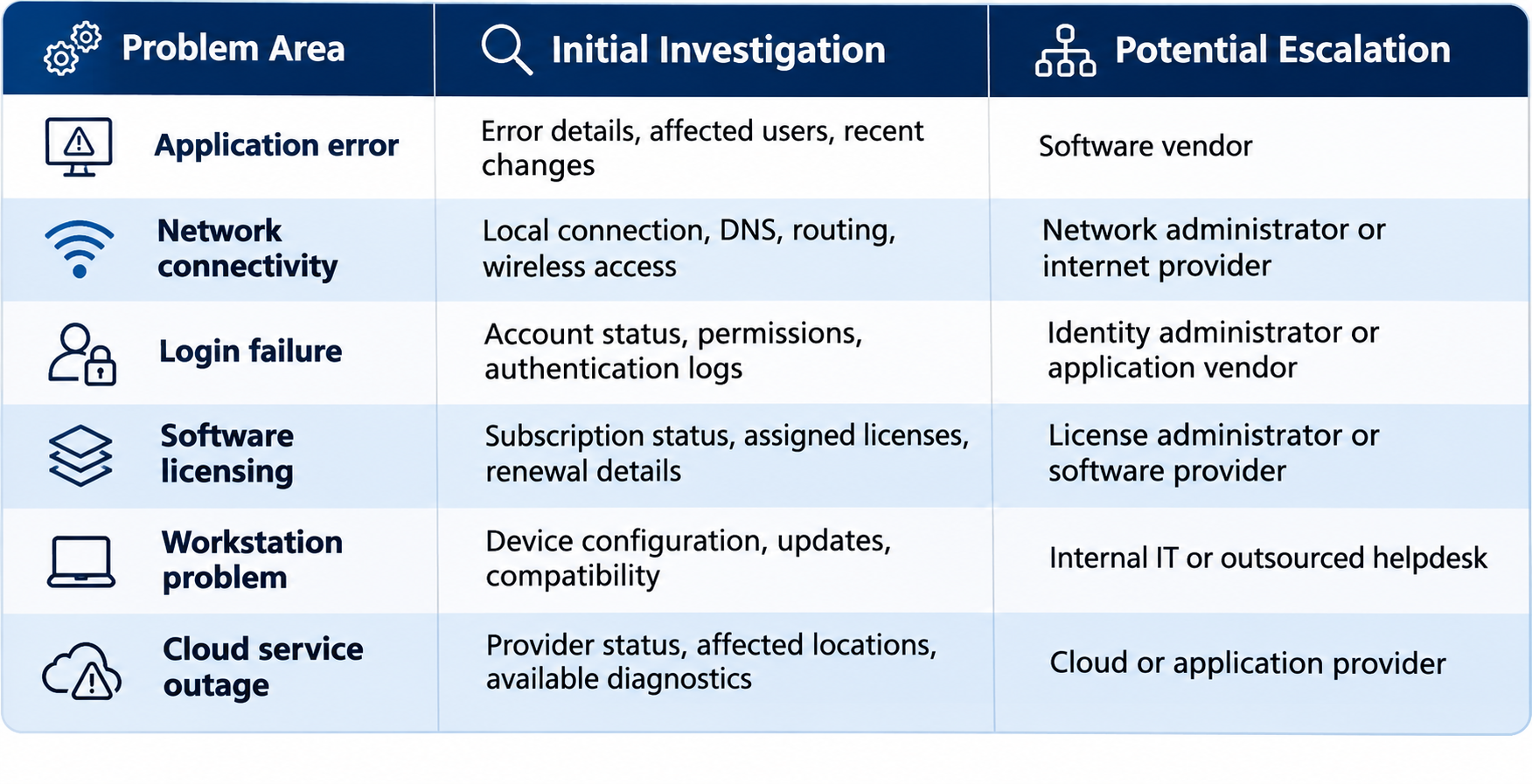
These responsibilities are examples, not automatic contractual assignments.
Businesses should document the actual ownership of each system and confirm which technical activities their support provider is authorized to perform.
How Outsourced IT Support Can Improve Escalation
A structured outsourced helpdesk escalation process establishes a consistent path from the first employee report to the appropriate technical resource.
1. Record the Problem Clearly
The initial support ticket should identify the affected application, users, devices, error messages, and business impact.
It should also record when the problem began and whether it occurs consistently or intermittently.
For some applications, diagnostic details such as error codes, request IDs, and timestamps can help identify the problem.
Microsoft's sign-in troubleshooting documentation, for example, explains how authorized administrators can use sign-in logs, error codes, and correlation IDs when investigating Microsoft Entra authentication problems.
2. Perform Initial Technical Checks
The support team can investigate likely causes within its authorized scope.
Checks might include comparing affected and unaffected devices, reviewing network access, examining account permissions, or determining whether the provider has reported a service interruption.
The objective is to gather evidence before transferring the ticket.
3. Escalate to the Responsible Provider
If the problem appears to involve a third-party system, the authorized support contact can share relevant findings with that vendor.
Microsoft's business application support guidance recommends documenting the problem, its impact, troubleshooting already performed, and relevant diagnostic details before opening a support request.
These practices can reduce repeated questions and help the receiving team understand what has already been investigated.
4. Track the Issue Through Resolution
Opening a vendor ticket is not the same as resolving the employee's problem.
A useful process records the vendor case number, the next responsible party, required follow-up, and any remaining actions.
It also confirms whether employees can successfully resume their work before the incident is closed.
If your employees repeatedly contact multiple vendors for the same unresolved problem, LAComputech can help review your support arrangements and discuss whether outsourced IT support could provide a clearer escalation process.
Set Clear Support Responsibilities and Escalation Procedures
A support provider cannot reasonably be expected to resolve problems involving every third-party application without the necessary access, expertise, agreements, and vendor cooperation.
Before purchasing outsourced support, define which activities are included.
Third-Party Software Vendor Support
Confirm which software providers handle product defects, application-specific configuration, licensing issues, integrations, and updates.
Some vendors may require an authorized administrator or designated customer contact to submit support requests.
Managed IT Vendor Coordination
When managed IT vendor coordination is included in an agreement, the provider may help collect technical evidence, communicate with other vendors, and track the agreed escalation process.
However, coordinating an issue does not automatically transfer responsibility for the software product itself.
LAComputech also provides Managed IT Services, but businesses should confirm the scope of any third-party coordination before selecting a plan.
Internal IT and Business Responsibilities
Organizations should identify who approves changes, controls administrative access, manages software contracts, and makes decisions when a disruption affects operations.
The NIST Cybersecurity Framework 2.0 emphasizes clearly established responsibilities between organizations and external providers for cybersecurity-related activities. The same accountability principle is useful when documenting technology support ownership.
Businesses with internal IT staff can also review LAComputech's co-managed IT versus managed IT guide when deciding how responsibilities should be divided.
Support Hours and Escalation Expectations
Confirm how incidents are prioritized, when assistance is available, and who communicates with employees during an unresolved issue.
Also distinguish response time from resolution time.
A support team may acknowledge a ticket promptly while a third-party vendor still needs to investigate or correct the problem.
Clearly defining these expectations helps prevent misunderstandings when multiple organizations participate in troubleshooting.
A Louisiana Business With Recurring Application Failures
Consider a hypothetical Louisiana accounting firm that uses a cloud-based application for financial reporting.
Several employees report that the application becomes inaccessible during busy periods.
The software vendor reports no widespread outage. The internet provider finds no general service interruption. Internal staff repeatedly restart workstations without identifying the cause.
Under a structured support process, the issue would be documented in one ticket.
The technical investigation could compare affected users, review workstation and network conditions, examine authentication errors, and check the software provider's service status.
If findings suggest an application-side issue, the designated contact could escalate the case with supporting evidence.
If the evidence points toward local configuration or connectivity, the appropriate technical team would continue investigating.
The outcome cannot be assumed in advance. The value of the process is that the incident has a defined owner, documented findings, and a clear next action.
Business Software Vendor Escalation Checklist
Before evaluating outsourced IT support, business owners and IT managers should review these questions:
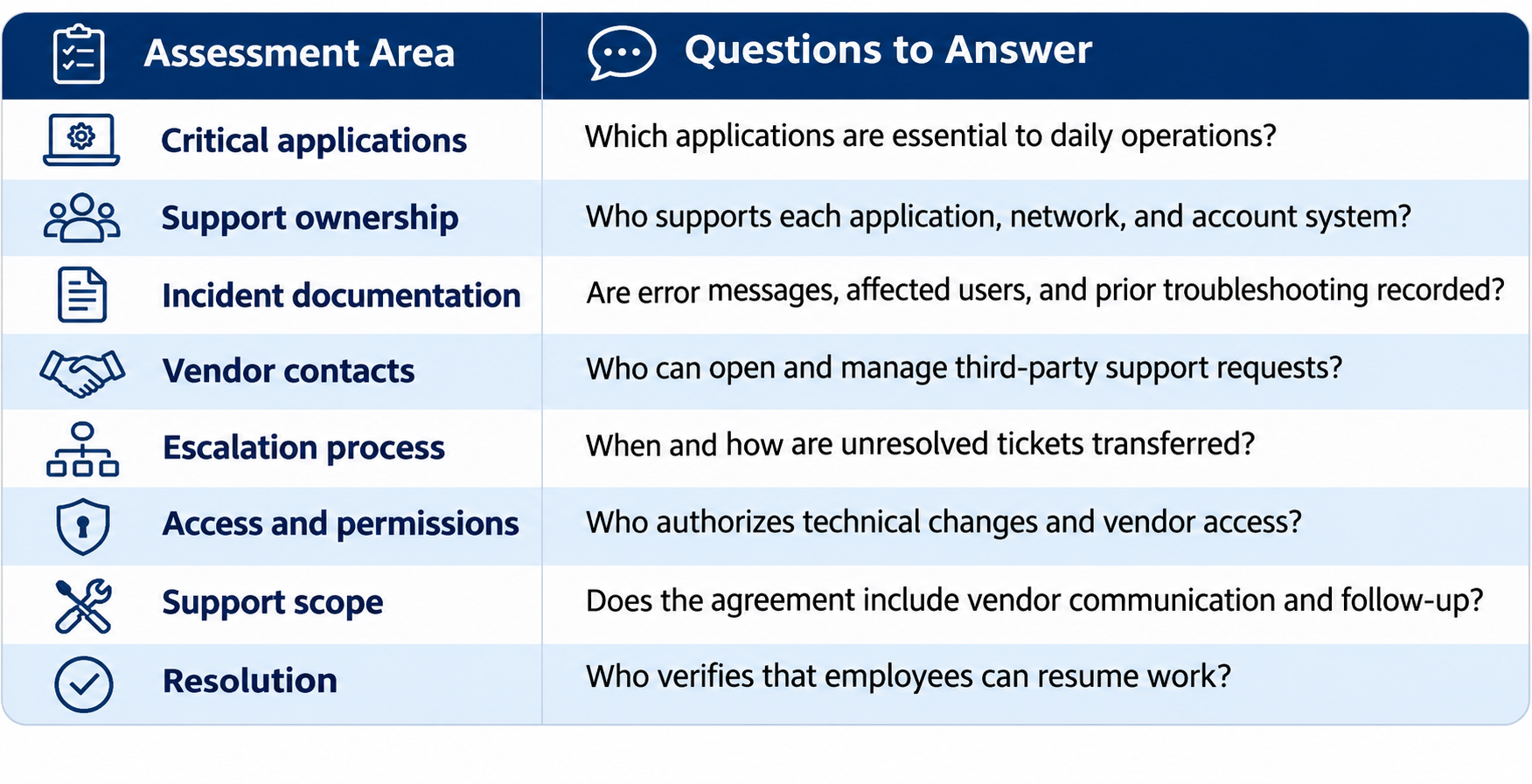
This checklist can help reveal where responsibility is missing or unclear.
Businesses should also review whether recurring tickets indicate a deeper problem that requires investigation rather than repeated temporary fixes.
Give Your Business a Clearer IT Escalation Process
When software companies, network providers, and internal teams disagree about an issue, employees need more than another support ticket. They need an organized path toward identifying the problem and reaching the responsible provider.
LAComputech offers outsourced IT support and helpdesk services for Louisiana businesses.
Are recurring software problems leaving your team stuck between vendors?
Call (855) 252-8324 or discuss your IT support needs with LAComputech.
Describe the applications involved, recurring issues, existing vendors, and current support arrangements so the team can discuss an appropriate outsourced IT support option.